· Events · 5 min read
DOE American Science Cloud experiments with NRP — ESnet tutorial at 7NRP
A recap of the DOE American Science Cloud (AmSC) tutorial that ESnet ran at the 7NRP workshop, covering the Genesis Mission context, the AmSC platform, and hands-on IRI Facility API work using NRP's training JupyterHub.
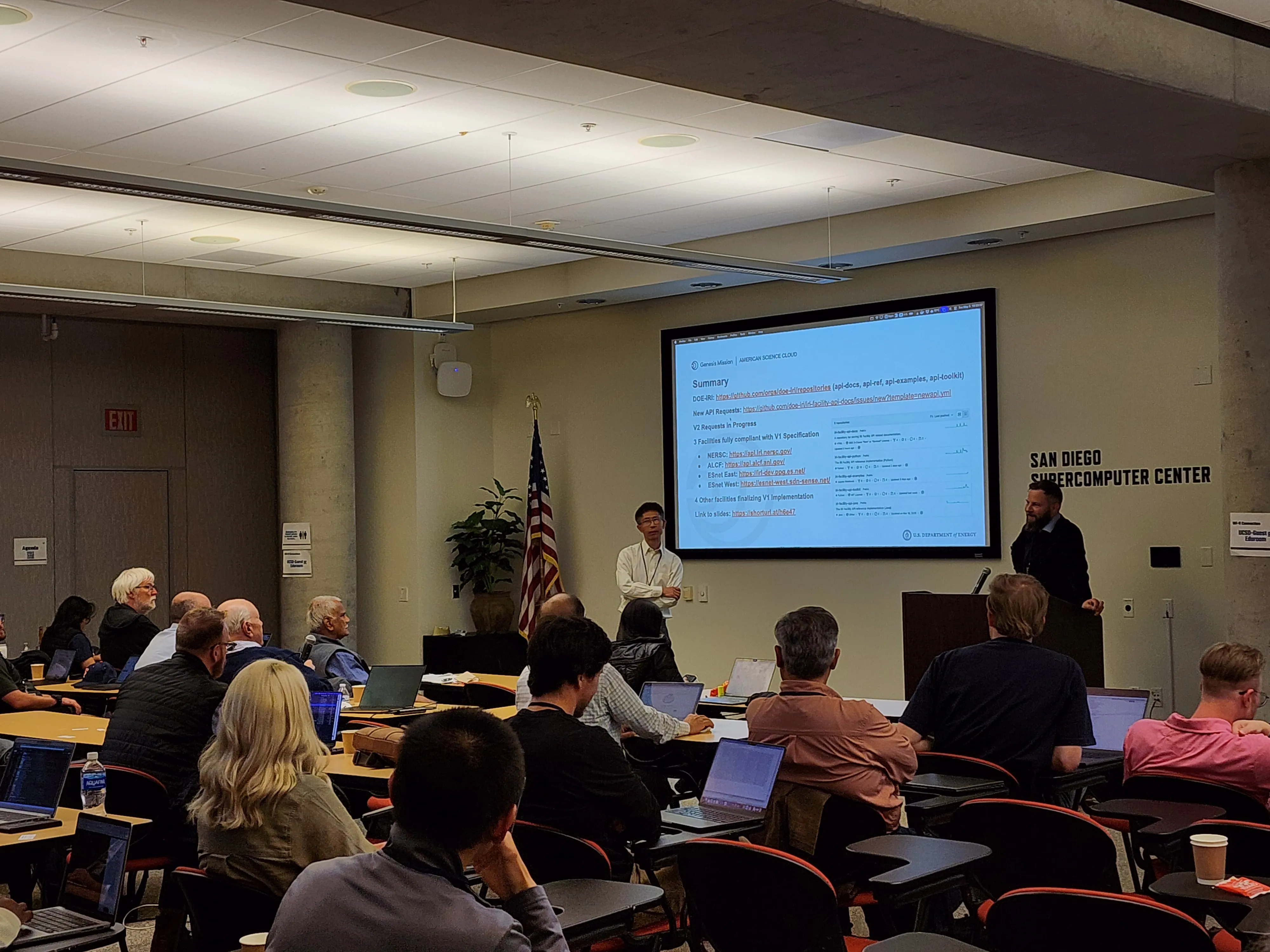
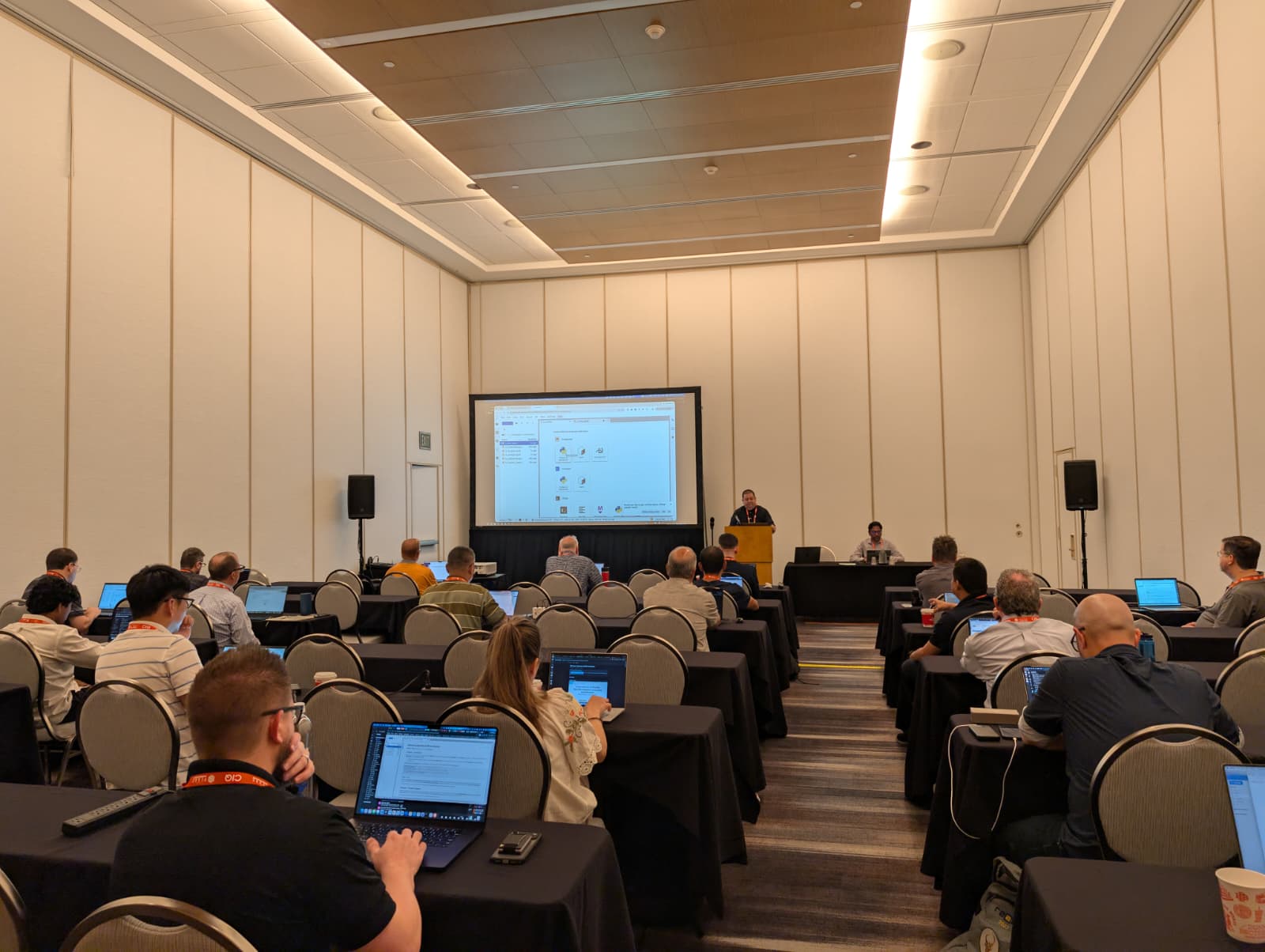
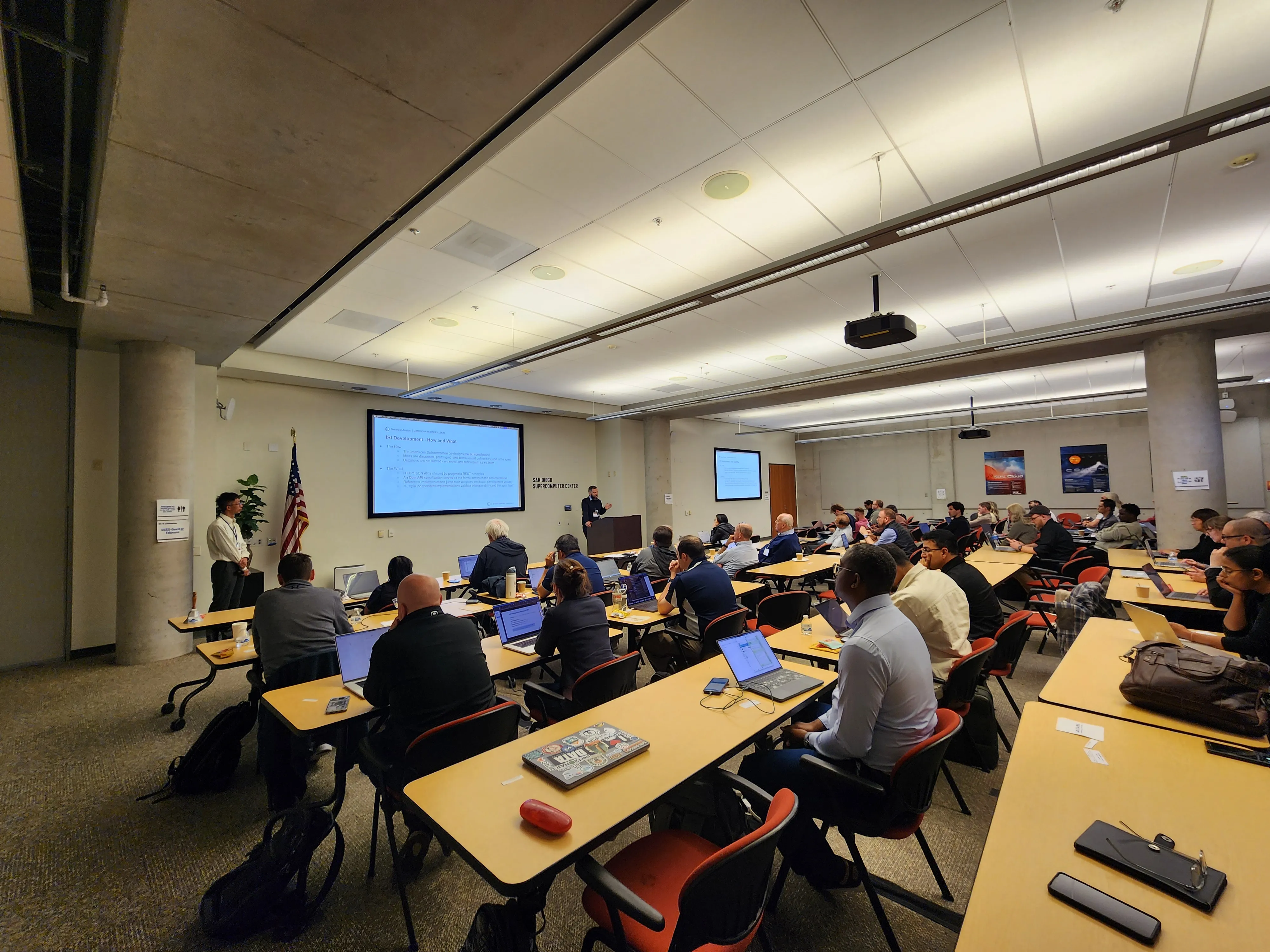
On Tuesday, May 5, 2026, the final Track A session of 7NRP Tutorial Day was “DoE American Science Cloud Experiments with NRP,” presented by Justas Balcas and Xi Yang (Pilots & Prototypes group, Energy Sciences Network / Berkeley Lab) in the SDSC Auditorium from 3:30 – 5:00 PM. The session walked the room through the design of the U.S. Department of Energy’s emerging American Science Cloud (AmSC) and explored what it would take to extend the AmSC stack to a heterogeneous, mixed-mode (partially dual-stack), multi-tenant Kubernetes cluster like NRP, then put attendees on a JupyterHub to exercise the DOE Integrated Research Infrastructure (IRI) facility APIs directly.
Materials
- 🖼️
DoE-American-Science-Cloud.pdf— slide deck (presented live) - 💻 doe-iri/iri-facility-api-examples — companion code repository with the hands-on IRI facility-API clients and notebooks
- 📋 Tutorial Day session folder on the 7NRP repo
- 🗓️ Full 7NRP agenda
Why AmSC, and why explore extending it to clusters like NRP
The talk opened with the policy context. On November 24, 2025, a White House Executive Order launched the Genesis Mission — “a national initiative to build the world’s most powerful scientific platform through AI” — with the explicit goal of doubling the productivity and impact of American research within a decade.
The American Science Cloud is the key building block of the Genesis Mission platform. Its charter is to deliver a seamless integration of DOE science instruments, computing, experimental facilities, and networking — together with AI, data, modeling, and simulation software — through a single advanced programming interface, the AmSC API. The pitch to scientists is concrete: unified APIs for data/model/workflow access, a federated VO-style identity model, interoperability between DOE facilities and commercial cloud service providers, and an explicit target of cutting time to insight from months to days through composable, AI-driven workflows.
AmSC’s Minimum Viable Product is scheduled for delivery in 12 months (by 9/30/2026), with a clean four-quarter ramp: Federated Access Foundation (VO + IRI integration) at 3 months, Science Team Onboarding (API Gateway + Data Catalog + Workflow) at 6 months, Intelligent Workflow (agentic workflow + AmSC API v1 + IRI orchestration) at 9 months, and the full MVP release (ASCR/CSP link, unified discovery) at 12 months.
NRP could directly connect to AmSC. AmSC’s Infrastructure Partners (IPs) include ASCR HPC (OLCF/Frontier, NERSC/Perlmutter, ALCF/Aurora, HPDF), ASCR Networking (ESnet), PNNL, Office of Science labs, applied energy labs, and commercial CSPs — and potentially the NRP, which could plug into AmSC as an IP through the same common abstraction layer everything else uses: the IRI-API (DOE Integrated Research Infrastructure API).
AmSC architecture in one paragraph
Justas and Xi framed AmSC as a control plane / data plane split: a Control Plane (“the Brains”) for orchestration, identity management and API routing; Facilities (“the Muscle”) for heavy computation and petascale data movement; and a Data Plane of high-speed science data routes (e.g. ESnet L3VPN). The whole stack is operated with a GitOps philosophy (ArgoCD for versioned infra/app config) and zero-trust identity (PingGIC issuing short-lived JWTs into both an MVP “Open Enclave” at FISMA Low and a future “Secure Enclave” at FISMA Moderate). The platform surfaces six core infrastructure services — Container Platforms, Storage Interfaces, Secure Enclaves, Job Scheduling, Resource Orchestration, and WAN Data Fabric — with the last two being the ones AmSC contributes most directly on top of partner facilities.
Every service AmSC ships carries an explicit Service Readiness label (Concept → Sandbox → Incubator → Candidate → Graduated → Archived) with associated user-access, API-stability and SLA promises. Everything demoed at 7NRP is in the Incubator stage — the room was invited to test the services as AmSC beta users and send feedback.
IRI Facility API v1 — what’s actually shipping
The hands-on portion centered on the IRI Facility API, the common interface every AmSC infrastructure partner implements. Version 1 covers six resource families:
- Facility — facility, site, location, resource
- Status — incident, event, resource
- Allocation — project, user/project allocation, allocation entry, capability, resource
- Compute — job, resource (PSI/J-style submit / live status / delete-cancel, with backends for SLURM, PBS, Kube Kueue, HTCondor)
- Filesystem — file, path, resource (asynchronous local ops — chmod/chown/stat/ls/mkdir/cp/mv/compress/extract/download/upload — complementary to transfer frameworks)
- Identity & Auth — VO-issued tokens routed through the AmSC reverse proxy and the GM Single Sign-On (Ping GIC) federated identity hub
A periodic Full Site Validation runs the same operationId checklist against every facility — DemoAdapter, NERSC, ALCF, ESnet West, ESnet East are already operational; ORNL, PNNL, SLAC and BNL are work-in-progress. The latest validation report is published at doe-iri/iri-facility-api-docs · verification/test_results/latest/full-report.md.
The roadmap to v2 extends the static resource model (DTN endpoints, networking connectivity, CUI-aware capabilities, facility topology with DTN↔storage↔compute connectivity modeling) and brings the IRI API into agentic workflows — a “chat with IRI endpoints” prototype that lets a model submit and monitor jobs across facilities via natural language was shown live.
Hands-on environment
The session ran on the same JupyterHub the rest of Track A used: training.nrp-nautilus.io. From a JupyterLab terminal:
git clone https://github.com/doe-iri/iri-facility-api-examplescd iri-facility-api-examplesThree notebooks, in order:
Login-nrp.ipynb— issue your own credentialsCompute-jobs.ipynb— submit a compute job against an IRI-API-backed facilityFilesystem.ipynb— local filesystem operations through the API
⚠️ The training JupyterHub is provisioned specifically for 7NRP and was spun down after the workshop concluded on Thursday, May 7, 2026. The notebooks and the slide deck remain available indefinitely. If you’d like to re-run these examples after the workshop — at your home institution, in a class, or for your own research — contact us on Nautilus Support and we’ll help you reproduce the environment on persistent NRP infrastructure, or point you to ESnet’s IRI testbed directly.